Plot: What’s it about?
The process of high school graduation can be a rough one, as students adjust for the move into real life. This comes naturally to some, who step up to college courses, settle down with a family, or find respectable work, but for some, the process isn’t so smooth. The latter is true for Riichi, a young man who gives in to his darker side whenever possible, mostly in the form of violence through street fights and minor crimes. Now he, his girlfriend Ryoko, and friends Yuji and Kotetsu have to make a path of their own life and in their case, hope isn’t high. These four friends have more than age in common, as none have families in their lives, so instead of a real bond with family, they lean on each other for support. Of course, that isn’t always there and in most cases, the bond is one of crime and anger, not love and support a family could offer. Soon after graduation, Kotetsu lands in prison for a violent crime, which leaves just three of the group intact. Ryoko takes a normal job, but the guys don’t want to surrender that fast. Riichi and Yuji dabble in the protection racket, a dangerous job, but one Riichi is well suited to handle. What will become of these wild teens, can they survive on their path, or will they succumb to the perils they seek out?
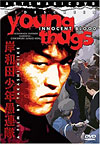
Takashi Miike (Audition, Full Metal Yakuza) burst upon the scene with a run of sadistic, off the wall motion pictures. But these weren’t his first works, as he has crafted numerous projects, both before and after his best known movies. These films aren’t as violent and chaotic as his better known pictures, but that doesn’t mean they’re not worthwhile. Innocent Blood is one of two films in Miike’s Young Thugs series, the other titled Nostalgia is also available from Artsmagic. Innocent Blood follows some of the characters from Nostalgia and while the order isn’t crucial, you’ll want to see them both to best understand Miike’s vision. As with Nostalgia, this movie doesn’t have wall to wall chaos and graphic violence, but it does have more bloodshed than that film. The blood sprays often and violence is frequent, but not the same kind of sadistic gore Miike fans might expect. The violence is also key to some plot movements, so this isn’t senseless bloodshed. Once again, the focus is on story and characters, just like in Nostalgia, but in truth, Innocent Blood is a deeper, more refined, and more effective motion picture. I haven’t seen all of Miike’s films, but of the ones I have seen, Innocent Blood has the deepest story and characters. I can’t recommend Innocent Blood enough, but make sure you also look into Nostalgia, to see the whole story unfold.
Video: How does it look?
Innocent Blood is presented in 1.85:1 anamorphic widescreen. As this shares similar video traits with Nostalgia, I will just port over my comments from that review. I haven’t seen all the different import discs on this title, but I’ve seen a few and all of those pale by comparison to this visual presentation. The print used is in perfect condition, with no grain, debris, or marks to be seen, a stunning start, to be sure. Then we have the streaming colors, which look as vibrant as possible, from the pastels to the deeper shades. Some scenes call for more vivid hues than others, but they look as intended. Just as impressive is the contrast, which supplies well balanced black levels and accurate detail throughout. This is simply a stunning transfer and of course, fans will be nothing short of thrilled with this treatment.
Audio: How does it sound?
The original Japanese soundtrack is preserved here, through a solid, but unmemorable Dolby Digital 5.1 surround option. This movie uses a natural scope for audio design, so you can’t expect over the top surround presence or some such. A few scenes do call for enhanced presence, but even then, this is not action movie type audio, just ramped up a tad. A solid amount of surround use is present in other scenes, but for the most part, its music or atmospheric effects. The dialogue is loud & clear also, which leaves me to score this one well. In case you need them, optional English subtitles are also included.
Supplements: What are the extras?
This disc includes a Miike interview, a featurette on Osaka’s culture, some talent files, and the film’s original trailer.