Plot: What’s it about?
Meg Altman (Jodie Foster) is a divorced women in her thirties, looking to find a new home for herself, as well as her young daughter Sarah (Kristen Stewart). The search leads her to a New York brownstone that doesn’t impress Meg all that much at first look, but it is soon revealed that it has more than meets the eye. The massive mansion is home to a special room, one that is sealed off from the others and has a ton of unique features, the room is called a panic room, the place you go when you’re in extreme danger. Once inside the panic room, you’re able to watch the rest of the house on numerous cameras, all while being sealed off from whatever poses the threat. This is enough to sell Meg on the place and of course, she begins to learn as much as she can about the panic room and how it operates. Soon however, she’ll get a crash course in its functions, when a trio of burglars raid the home and while Meg thinks she & Sarah are safe, it seems as though what the burglars seek lies within the panic room itself. Can Meg and Sarah outlast the invaders, who work to open up the panic room and takes what lies inside?
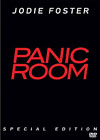
I’ve been sold on Panic Room since I read a brief synopsis of the premise, as it had an excellent basic storyline, a great cast, and the direction of David Fincher (Fight Club, The Game). But then Nicole Kidman pulled out of the project, though she was replaced by Jodie Foster, so it all worked out well enough. In the end, Panic Room wasn’t as good as I had hoped, but it supplies some nice visuals, eerie atmosphere, and some solid performances. Foster is joined on screen by such names as Dwight Yoakam, Jared Leto, and Forest Whitaker, all three of whom seem in fine form as the invading criminals. I do wish it was darker in tone and relied less on cheap pops, but even so, Panic Room was fun to watch. As I watched Panic Room again for this new edition, I was more impressed with the attention to detail. The visuals came alive for me this time around, so perhaps I paid more attention or was more open to the experience. I still think it falls into a lot of the usual thriller traps, which kind of dull the tension, but that is expected. Columbia’s first release was a single disc Superbit, but this time, we have a loaded three disc Special Edition. We lose the DTS track, but gain an enhanced Dolby Digital 5.1 option, not to mention a slew of supplements. So if even if an upgrade is in order, this new version of Panic Room is well recommended.
As I stated before, the central role in Panic Room was first given to Nicole Kidman, then took over by Jodie Foster soon after the production started. Foster brings a stronger, more powerful presence to the role, while Kidman would have seemed more helpless, an interesting contrast that would have wildly altered the entire picture. But I think Foster reels in the character well and comes across with a terrific performance. Of course, we’ve seen her in countless terrific performances before, so that shouldn’t come as a surprise. I do think the lack of time to prepare hurt her effort a little, but she doesn’t stumble too much, even with only a little over a week of time to prepare, no small feat indeed. Other films with Foster include The Accused, Contact, The Silence of the Lambs, Taxi Driver, and Little Man Tate. The cast also includes Jared Leto (American Psycho, Urban Legend), Dwight Yoakam (The Minus Man, Sling Blade), and Forest Whitaker (Battlefield Earth, The Crying Game).
Video: How does it look?
Panic Room is presented in a 2.40:1 anamorphic widescreen transfer. This is the same transfer found on the previous edition, but no need for concern, as the presentation is more than up to the task. As this movie is very, very dark in terms of visuals, its an uphill struggle to maintain a top level picture, but with only a few exceptions, this presentation holds firm and handles this high difficulty level material. In a handful of scenes however, the black levels become a little too dark and in others, the image is a tad on the soft side. But even in those moments, you should be more than pleased with the visuals, so I can’t knock this treatment too much. The colors come across well also, while detail remains as intended, though since this is an extremely dark movie, you won’t always have a lot to look at. I expected perfection here and while I didn’t get that, Columbia has served up a top drawer visual effort in all respects.
Audio: How does it sound?
I wasn’t too thrilled with the audio on the first release, because it relied on power and often neglected subtle touches. So dialogue was thin and small impact audio wasn’t memorable, which was a real missed chance. This time around, we only have a Dolby Digital 5.1 option to screen, but this is a new, enhanced soundtrack. I know a lot of folks will be let down by the lack of a DTS track, but this one puts the previous tracks to shame. The depth and power remain the same, perhaps even better in some scenes. The difference comes in those subtle cues, which now have a more potent, marked presence. This adds a lot to the atmosphere and overall tension, which is quite important in a film of this kind. I found dialogue to be more crisp and a tad louder also, which means all the woes of the previous version have been solved here. This release also includes Spanish and French language tracks, as well as subtitles in English, French, and Spanish.
Supplements: What are the extras?
The first disc in this collection houses the film’s theatrical trailer, as well as a total of three audio commentary tracks. David Fincher provides the first session and as always, he is candid and provides an endless assortment of insights. Fincher discusses the various cast & crew changes made during the production, with no pretense whatsoever. He also talks about the cast, but most of the time, he focuses on technical details. The second track is with writer David Koepp, which is joined by William Goldman, who keeps the track moving forward. Koepp has a lot to say about how different the film would have been with the original cast intact, as he wanted to see Nicole Kidman in the lead role. The last session is with several cast members, as Jodie Foster, Dwight Yoakam, and Forest Whitaker discuss the production. This was a fun track, as all three seem to be open and quite talkative. You’ll hear some back-patting at times, but for most of the track’s duration, the speakers remain on topic.
Next up is the second disc, which includes sections on Pre-Production and Production. The former holds a total of six featurettes, some of which runs only a few minutes and others that clock in at over half an hour. You’ll see special effects test shots, a look at the art of cracking a safe, and even how an intricate shot was blocked. The best of the lot is a half hour piece that lets you compare storyboards and test footage with the finished product. You can even alternate between raw audio, the finished soundtrack, and two audio commentary tracks. In the Production section, you’ll find a nine minute featurette on the film’s makeup effects, but the real jewel is Shooting Panic Room, an extensive behind the scenes documentary. This pieces runs about an hour and blends insightful interviews with real footage from the production. So this is not the usual fluff piece, instead we get a real look inside of Panic Room’s shoot.
The third and last disc holds the rest of the supplements, but don’t give up yet, as there is ample material left. In the Production area, you can browse a collection of four scenes, which have been broken down for us to experience. You can follow the scenes from script to storyboards to test reels to finished product. This proves to be an excellent inclusion, as it is a real revelation to be able to see how the scenes evolve. We move to the Post-Production section now, where we find a massive number of brief featurettes. Each of these over twenty featurettes focuses on a specific scene, from the opening credits to assorted special effects sequences. So we can see the ins & outs of how each one was created. This final disc also includes a multi-angle scoring session, a look at the film’s sound design, a featurette on color timing, and a special piece on Super 35, which explains the subtle details in easy to follow fashion.