Plot: What’s it about?
“Badges? We ain’t got no badges. We don’t need no badges. I don’t have to show you any stinking badges!â€
When “The Treasure of the Sierra Madre†was made, Humphrey Bogart was already a well-established star. He had not yet won an Academy Award (he’d have to wait until 1951’s “The African Queen†for that), but some of his performances were already etched in the minds of the American public. With this movie, he created a much darker character and some say that it’s his best performance. Unlike his roles as Rick Blaine in “Casablanca†and Frank McCloud in “Key Largoâ€, Fred C. Dobbs was a supposedly decent man, just down on his luck. Based on the novel by B. Traven (who supposedly existed, but no one ever met him face to face), the project interested Director John Huston during the mid-30’s. However, it got put on the back burner for years and Huston went off to war. It wasn’t until he returned that he actually made the movie and his choice of the lead was Bogart as the troubled Dobbs. Huston cast his own father as that of an old prospector who spins tales of gold and riches. They would both win Academy Awards (John for Screenplay and Direction and Walter for Best Supporting Actor). It was the first father/son win in Oscar history.
The movie, though, was that which most audiences had never seen. Humphrey Bogart was known for playing the male lead and this was a cry back to this days as a gangster when he was still playing second fiddle to James Cagney in films like “The Petrified Forest†and “Angels With Dirty Facesâ€. What makes the film so memorable is the fact that it’s one of the few that has delved so deep into the human psyche. It’s probably the definitive film about green, human nature and paranoia. There is a line form “Wall Streetâ€, uttered by Michael Douglas’ Gordon Gecko that says it simply: “Greed, for lack of a better word, is good. Greed is right…â€. These are words that Frec C. Dobbs (Bogart) and his friend Curtin (Tim Holt) could understand, to be sure. Though not a commercial success at the time, the film was critically praised and it was rumored that Jack Warner (head of Warner studios) was the film that he was most proud of. Nominated for four Academy Awards, it won three (losing Best Picture to Lawrence Oliver’s “Hamletâ€). This movie, though, showed depth for Bogart, depth that many thought didn’t exist.
The movie starts off simply enough; we meet Fred C. Dobbs (Humphrey Bogart) as he is down on his luck in Tampico, Mexico. Begging for money, he gets a few meals staked by what appears to be a wealthy American (Director John Huston in a cameo). Meeting up with another American, Curtin (Tim Holt), the two are taken advantage of while working on an oil rig. It turns out to be a scam and their weeks of hard work have only paid off in blisters and pain. As luck would have it, though, the two meet the man who owes them their money and after a bar room brawl, they take only what is theirs. As time goes by (no pun intended), the two meet up with an old prospector (Walter Huston) who spins tales of gold and riches. Figuring they have nothing else to lose, they agree to go in the Sierra Madre Mountains and see if they can find their fortune. The three are bound only by trust and the desire for fortune as they set out on a journey that will change their lives forever.
As they find out, gold isn’t sitting around in the form of nuggets, they have to look closely for it and once it’s found, it still looks like dirt. On the verge of frustration, the three finally hit the mother lode. However, as bags of gold begin to accumulate, Dobbs begins to change. He suggests that the three be responsible for their own share of the gold and each find a hiding place for it. Seeing no problem, they agree. Dobbs had said that when he started, he’d only get $5,000 worth and leave. Now that the gold is ripe for the taking, though, each tends to want as much as they can carry. The lands of Mexico are no place for greed, though. Lawlessness abounds and in one of the movie’s most famous scenes, bandits attempt to buy the guns from the prospectors; only to be run off. As Dobbs’ paranoia starts to take over, they split up. Curtin and Dobbs are heading back to town while Howard (Huston) must head to an Indian village to pay off a debt. It’s at this time that Dobbs’ greed takes over…
The movie was probably Huston’s greatest ever, on par with that of “The Maltese Falconâ€. Bogart was never better and it’s a shame that his Oscar would come for the role of Charlie Allnut in “The African Queen†instead of this (not that he wasn’t deserving in that). Tim Holt was hoping that the success of this movie would lift him out of the “B†movies that he has starred in before, but it did not. As for John Huston, the sometimes actor/writer/director would go onto make many more great movies and even play one of the best villains in “Chinatownâ€. His father, Walter, would make three more movies after this and died in 1950. Even today the movie still gathers accolades as it was recently selected to the American Film Institute’s list of the Top 100 movies of all time (#30). “The Treasure of the Sierra Madre†remains a classic for one undying reason: few movies have delved so deep into the soul of man to reveal human nature.
Video: How does it look?
Much like that of “Yankee Doodle Dandyâ€, “The Treasure of the Sierra Madre†sports a re-mastered picture. The film is some 55 years old now and it looks better than most its age. A majority of the scenes have a very clear, bright picture that looks great on any size television. However, there are a few scenes, mostly at night, that have bad scratches on then and some heavy artifacting. Granted, these only last for a few seconds, but it’s enough to knock the score down a point or so. Black and white movies don’t show the errors seen in a color picture. Edge enhancement isn’t much of a problem here and there’s a number of scenes that look positively great on DVD. The odds are, though, that the viewer will be so engrossed in the story as to worry about what the picture looks like at all. That being said, “The Treasure of the Sierra Madre†has never looked better and what better way to present it that like this.
Audio: How does it sound?
Naturally, the sound mix here is the original mono. Mono isn’t that bad, but when we’re used to sounds of all types coming out of every channel, it takes a bit of getting used to. The soundtrack of “…Sierra Madre†helps establish the mood and it varies from that of impending doom, to almost a happy circus theme from time to time (I compare it with that of “Jawsâ€). There is the slightest bit of distortion in some scenes and Bogart’s words seem to have a somewhat raspy sense to them. I have to admit that I’m “on the fence†when it comes to re-mastering older mono films into that of 5.1 sound. Yes, the sound will be a little more robust, but for the purists out there, mono is the way to go. It doesn’t matter, I suppose, as that isn’t the case here. What you’ll get is a great representation of the original mono soundtrack.
Supplements: What are the extras?
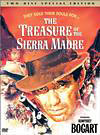
“The Treasure of the Sierra Madre†comes to us in a two-disc Special Edition (something I’ve been wanting to type for some time now). The first disc contains the movie with a commentary by Eric Lax, Co-Author of “Bogartâ€. Lax gives a very informative commentary track here. He obviously knows his stuff and though not a whole lot of information is learned, we learn a lot more about the man instead of the movie. No matter, because there’s plenty more features for us to learn about the movie. As is the case with “Yankee Doodle Dandy†and “The Adventures of Robin Hoodâ€, this contains an introduction by Leonard Maltin who gives us a “Night at the Movies†for the year 1948. A trailer for Bogart’s “Key Largo†is shown as is a newsreel (though with the war now over, the contents are now of flood and tornado victims), a short “So You Want to Be a Detective†as well as a Looney Tunes short “Hot Cross Bunnyâ€.
The rest of the features are on the second disc and we start out with a great documentary on John Huston. Hosted by Robert Mitchum (this dates the documentary a bit, as Mitchum died over 5 years ago), this takes us on a path from his days directing “The Maltese Falcon†up to his later movies like “Prizzi’s Honorâ€. Of course, everything in between is also covered. For anyone wanting to know about John Huston, this is a good place to start. Next up is a documentary “Discovering Treasure: The Story of ‘The Treasure of the Sierra Madre’â€. John Millus (Director) narrates as we’re taken on the trip that was the making of this movie. Interviews with Huston’s ex-wife as well as Martin Scorsese, Leonard Maltin and Robert Osborne tell us all we need to know about the making of this movie. I have to believe them when they say “… it’s a miracle that this movie ever got madeâ€! Also shown is a classic cartoon “8 Ball Bunnyâ€. Some cast and crew bios are shown as are some still galleries of the set and some promotional materials. The Lux Radio Theater has an audio-only portion as Humphrey Bogart and Walter Huston recreate their screen roles to the delight of the audience. Odds are that there will never be another movie like this, but until (or if) there is, we have the definitive version of this. Highly recommended.