Plot: What’s it about?
The older I get, the more I realize that the movies I see mean more to me than them being simply films. They’re a timestamp of a time and place when I saw them. The same goes for books I’ve read, music I’ve listened to and so on. You get the idea. Case in point, it was the Spring of 1996 and I’d just transferred to a new school, Kansas State University (if anyone out there cares). I didn’t know a soul, but my cousin and her husband lived not too far away in Kansas City. So I’d often head up there for the weekend and we’d catch a movie. As anyone might have guessed, Happy Gilmore was one we saw and, dare I say it, it was an instant classic. This was a time when Adam Sandler wasn’t the star he is now, rather a former SNL cast member who’d had moderate success with Billy Madison the year prior. Add to the fact that the sport of golf wasn’t what it is now. This was just a few months prior to Tiger Woods turning pro and making golf a mainstream sport. Did Happy Gilmore eerily predict the rise of a “rich sport for white guys” or was this just Adam Sandler exercising his sophomoric comedy to new levels?
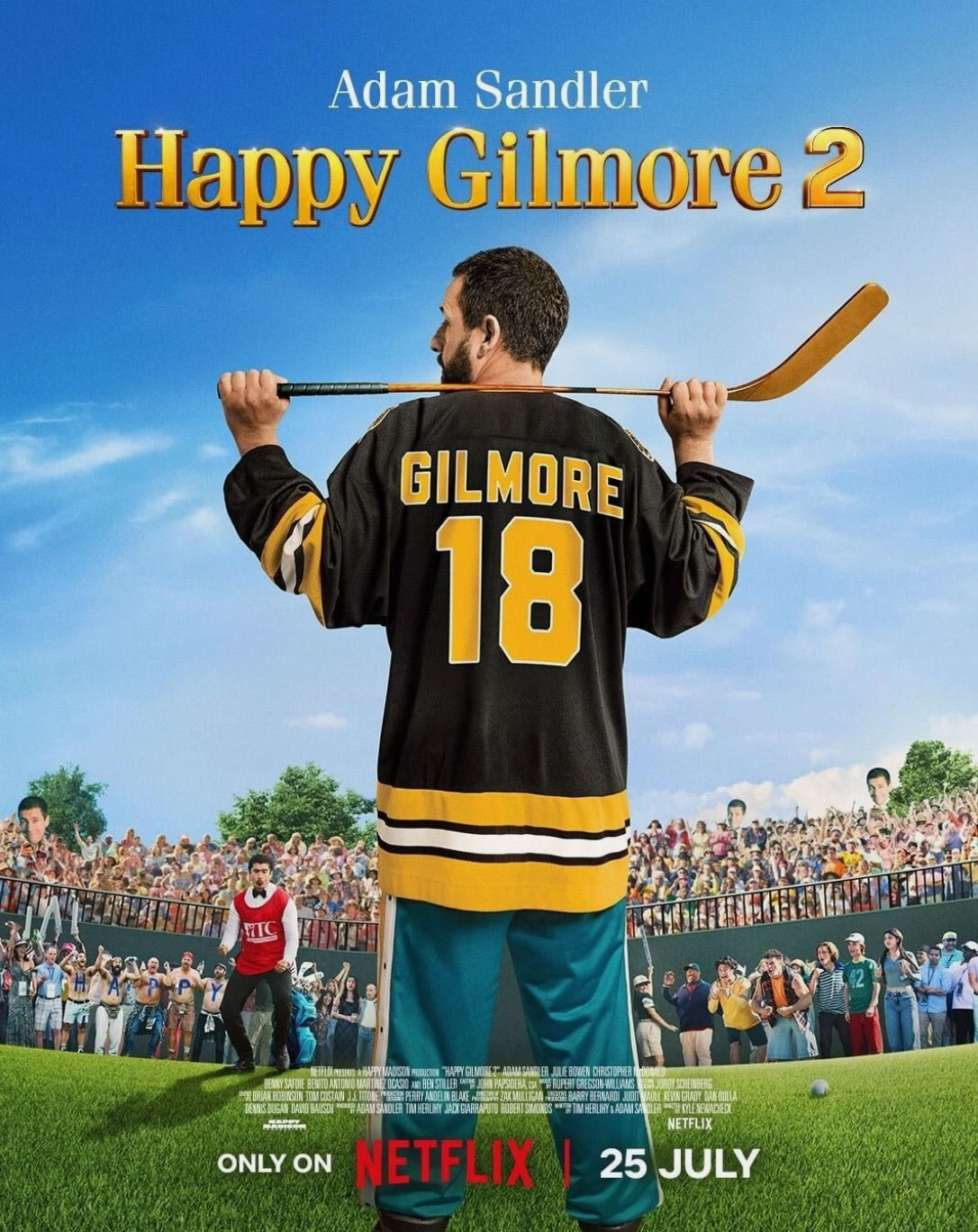
Nearly three decades have passed for Happy Gilmore (Adam Sandler). He’s had highs as a golfer, but has since quit the sport to focus on his family along with his wife, Virginia (Julie Bowen). However, tragedy strikes in the first few minutes of the film and his shanked ball kills her. The event sends Happy spiraling out of control losing his finances, his possessions and into a rut of alcoholism. Happy, along with his five children, are forced to move to the slums, but Happy has to once again find his mojo to help send his daughter, Vienna (Sunny Sandler), to a prestigious ballet school in Paris. Happy seeks out the advice of golf guru John Daly (playing himself) as well as the son of Chubbs Peterson (Carl Weathers from the original). He also has to contend with the rise of a Maxi tour that attempts to give golf a little more pizazz and, as always, there’s his nemesis – Shooter McGavin (Christopher McDonald) that may or may not have shed his 30-year grudge against our titular star.
There are very few sequels that hold up to their predecessors after three decades. An obvious one that worked was Top Gun: Maverick. But Adam Sandler is no Tom Cruise. And with that film, it gave us more of what made the first one so successful. Happy Gilmore 2 seems to take another, less successful, approach by putting anyone and everyone in some sort of cameo. Professional golfers, rappers, actors, sports stars – you name it – they’re in it. And very few add much to the film other than Haley Joel Osment and Benny Safdie (who directed Sandler in Uncut Gems). I had high hopes for this one, but deep down I knew that it would never live up to the original. Containing flashbacks galore to remind us of what we were hoping for, this one has some genuinely funny scenes, but anything and everything that seemed to work in the first one is used and reused here. Time and again. Happy Gilmore is up there with my favorite films along with Caddyshack and Major League. Both of those sequels are on par (pun fully intended) with this one. Perhaps they should have quit while they were ahead?
The Bottom Line
This would have been a good movie…in 1999. Simply put, too much time has passed since the original. The plot had hope and it’s oddly relevant with the rise of the LIV tour. But I don’t think too much thought went into that aspect. Cameos galore somewhat sour the spirit of the original. It’s worth a watch if you’re a die-hard fan, but likely the first one is where the magic is. It was for me.